

In today's fast-moving landscape, where creativity and content are everything, a great many brands are betting on UGC (user generated content). If your goal is to work with them, having a visually compelling portfolio is essential if you want to stand out from the competition.
User generated content rests on authenticity and a genuine connection with an audience. If you can make videos that carry that, it is time to build a portfolio and start approaching brands.
If you are not yet familiar with UGC, or you are not sure how to work it into what you do, this article explains it in detail.
And what better way to show your work and experience in UGC than through a portfolio?
What is a UGC portfolio and what is it for?
A portfolio is essentially a collection of the work and projects you have produced over the course of your career. It usually includes examples of past work, relevant projects, descriptions of your creative process and the results you achieved. It can be physical or digital, and it is most often presented as a web page.
Its main purpose is to show your skills, your creativity and the services you offer.
It is fundamental to introducing yourself to brands and letting them see how you work.
Where to build a UGC portfolio, and which platforms to use
Below we go through the most effective platforms for building a UGC portfolio, what each one does well, and how they can help you connect with your audience and future collaborators.
Canva
Canva is an excellent choice, especially if you have no experience with web design.
Canva is extremely easy to use. You can lay out your portfolio intuitively, with no design or coding knowledge at all.
It offers a wide range of ready-made templates for portfolios, all easy to customise. They are built to show your work professionally and attractively.
One advantage of Canva is that it lets you produce both a digital portfolio, to share online, and a physical one for print — which gives you flexibility depending on what you need.
Wix
Wix is a website builder that gives you a professional finish.
It is very intuitive, and you do not need to be a web design expert to build an attractive portfolio. Its drag-and-drop system makes it easy to organise your content and customise how the site looks, and it offers plenty of templates built specifically for portfolios.
Sites built on Wix are fully mobile responsive, which is essential these days.
It also includes SEO tools that can help improve how visible your portfolio is in search engines.
Wix offers free plans (with limitations, such as Wix's own ads) and premium plans with more functionality, so you can pick whatever suits your budget.
Squarespace
Squarespace is another excellent option, particularly if you want a platform that combines ease of use with high-quality design and a professional web presence.
Squarespace is known for its modern, visually striking templates. They are designed to feel premium and are perfect for presenting your work elegantly and professionally — useful when you are trying to impress brands or prospective clients.
It is built specifically to present images and visual content well, with features like photo galleries, carousels, full-screen views and transition effects that let your work land.
If you want to sell services or products straight from your portfolio, Squarespace has ecommerce built in, so you can set up an online shop if you need one.
It offers a free trial, but eventually you will need to choose a paid plan.
What a portfolio should contain
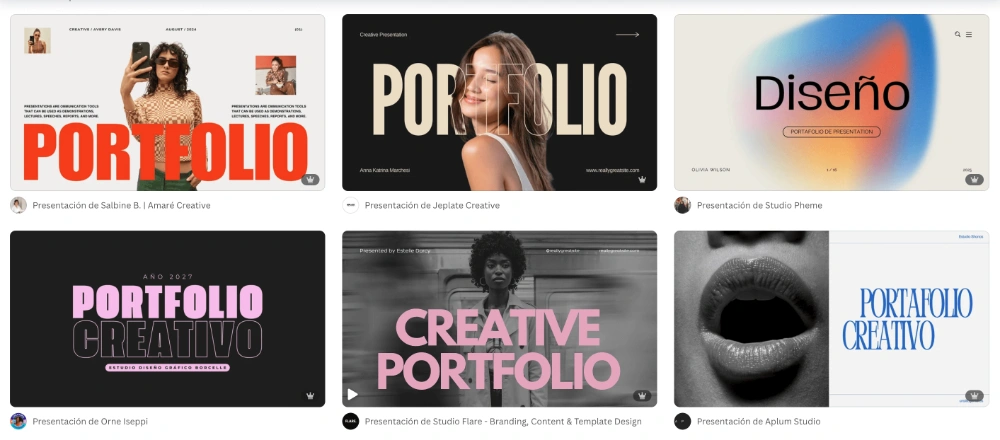
Here are the essential elements a UGC portfolio needs to be attractive and effective. From the cover through to testimonials, we will cover everything you need to build a portfolio that shows off your work and attracts brands.
The cover
What kind of introduction would it be if you did not start by introducing yourself and making it possible to contact you directly?
Image matters, and the first slide is the place for your photo. Make sure it is one that catches the eye of the brand looking at it. It can be a studio shot or something taken on your phone with your own UGC gear — as long as it is good quality.
Your introduction
Introduce yourself, including anything that sets you apart from other creators. If you have experience in a particular sector, for example, say so.
Examples of recent work
Once you have a few pieces in your portfolio, it becomes far easier for brands to see how you can add value to their business by creating content for them.
Include a range of videos — different sectors, different editing styles — so brands can see everything you are capable of.
What people say about me: testimonials from satisfied clients
UGC is a business. Positive reviews from clients strengthen your case as a creator. Wherever you can, add statistics or figures that back up the content brands have used, and explain the challenge the brand faced and how you delivered the right solution.
Services and packages
This is where you set out the different services you offer brands: video, photography, copywriting and so on. And if you have thought them through, a few packages that make it easier for a brand to put an offer together.
Phone and website
This is the moment to close with a line that prompts action, inviting the brand to take the next step and get in touch, whether by phone or email.
It is also worth adding a visual detail — a decorative element or your own logo — that helps you stand out and makes you recognisable.
And finally, do not forget your contact details: email, social profiles and phone number, so people can reach you easily.
10 steps to building your UGC portfolio
Building an effective UGC portfolio is fundamental to standing out as a creator and attracting brands, clients or agencies.
In these 10 steps we will take you through the process of creating a portfolio that lands, from defining your goals to keeping it up to date. Let us begin.
Step 1: define your goals and your strategy
It is crucial to think about who will receive your portfolio — who it is aimed at and what purpose sits behind it. Ask yourself whether you are building it to find work, to attract new clients for your agency, or to enter a competition. It also matters whether you are addressing companies, individual clients or other agencies in the sector.
Step 2: create a Canva account (if you do not have one)
Set up a free account on Canva and log in.
Step 3: choose a template
You can start from a template or from scratch. Canva offers a wide range of templates well suited to portfolios, so take your time exploring and pick the one that fits your style.
Step 4: organise your content
Start by adding your best work. Make sure you choose a variety of content types to demonstrate your range and creativity.
Step 5: customise it creatively
Canva makes customising your portfolio quick and easy, so it fits your brand or personal style exactly. You can change colours, fonts, backgrounds and much else to build something that genuinely reflects who you are and leaves an impression. Make it yours.
Step 6: introduce yourself to brands
Include a bio and your contact details. Add a short biography highlighting your skills, experience and what makes you distinctive as a creator. Make sure your contact information is there too — email, social profiles and phone number — so prospective partners can reach you easily.
Step 7: visual flow and narrative
Your UGC portfolio needs a clear structure that guides the viewer intuitively. Follow an order, visual and narrative alike, so the whole thing makes sense as a sequence.
Step 8: review it
Check that everything is right. Make sure there are no errors and that the portfolio is visually appealing and works properly.
Step 9: share it
Generate a shareable link and you are ready to go.
Step 10: keep it up to date
As you make more content and produce new kinds of video, add them to your portfolio to keep building its value.
What your portfolio should NOT include
While it is essential to show the best of your work in your UGC portfolio, there are things you should leave out to protect the quality and professionalism of what you present. Here is what NOT to include:
❌ Low-quality content
Some examples of what to leave out:
- Low-quality content or badly edited photos and videos
- Inappropriate or controversial content
- Content that does not reflect your brand or personal style
- Excessive promotion or spam-like content
❌ Your rates
This one is delicate and depends on the situation. Generally, though, publishing your rates in a portfolio has three possible outcomes:
1. Brands decide your rates are too high, and rule you out in favour of someone cheaper.
2. Brands decide your rates are too low which, even if they never say so, means they accept them without ever offering you what you are actually worth.
3. Brands decide your rates are reasonable. That sounds ideal, but it limits your ability to negotiate better terms. It is always worth leaving room to negotiate.
❌ A lecture about UGC
Please avoid including a section explaining why UGC is "the next big thing in marketing". If a brand is looking at your portfolio, they almost certainly already understand what UGC is worth — that is precisely why they are considering you. If you are doing cold outreach and doubt the brand knows the concept, make that point in your introductory email, not inside the portfolio.
In short: building an attractive, professional UGC portfolio is fundamental to standing out as a creator.
And if you are taking your first steps and want to know more about becoming a UGC creator, this article has everything you need.